

TEXTILE ART | Reiko Sudo: An Alchemist Turns Humble Materials into Unexpected Works of Beauty and Cutting-edge Design
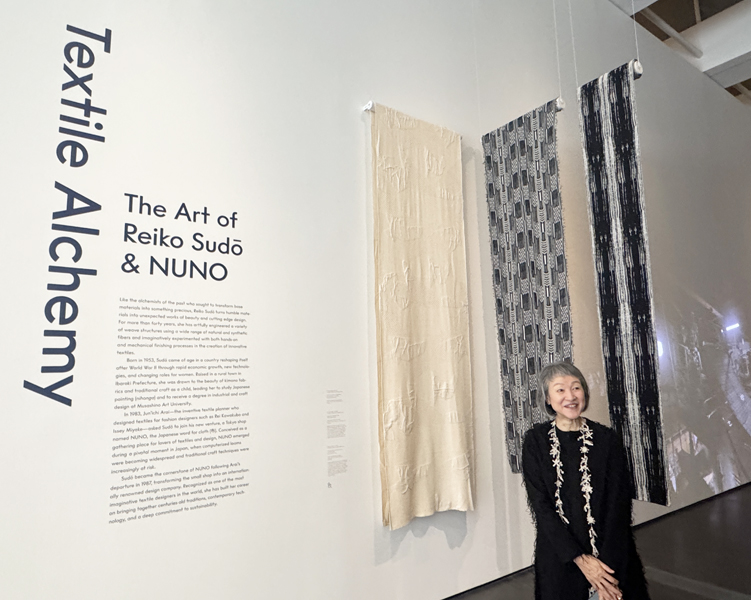
Textile Alchemy: The Art of Reiko Sudo & NUNO
September 20, 2026 – March 7, 2027
Resnick Pavilion, Los Angeles County Museum of Art
Like the alchemists of the past who sought to transform base materials into something precious, Reiko Sudō turns humble materials into unexpected works of beauty and cutting-edge design. For more than forty years, she has artfully engineered a variety of weave structures using a wide range of natural and synthetic fibers and imaginatively experimented with both hands-on and mechanical finishing processes in the creation of innovative textiles.
Born in 1953, Sudō came of age in a country reshaping itself after World War II through rapid economic growth, new technologies, and changing roles for women. Raised in a rural town in Ibaraki Prefecture, she was drawn to the beauty of kimono fabrics and traditional craft as a child, leading her to study Japanese painting (nihonga) and to receive a degree in industrial and craft design at Musashino Art University.
In 1983, Jun’ichi Arai—the inventive textile planner who designed textiles for fashion designers such as Rei Kawakubo and Issey Miyake—asked Sudō to join his new venture, a Tokyo shop named NUNO, the Japanese word for cloth (布). Conceived as a gathering place for lovers of textiles and design, NUNO emerged during a pivotal moment in Japan, when computerized looms were becoming widespread and traditional craft techniques were increasingly at risk.
Sudō became the cornerstone of NUNO following Arai’s departure in 1987, transforming the small shop into an internationally renowned design company. Recognized as one of the most imaginative textile designers in the world, she has built her career on bringing together centuries-old traditions, contemporary technology, and a deep commitment to sustainability.
Experimentation
When Sudō took the helm at NUNO in 1987, many colleagues insisted that a woman could not succeed in the textile industry. But Sudō, who invested her own life savings into the business, refused to fail. She began collaborating with weavers, dyers, artisans, and chemical engineers across Japan, drawing on both traditional and unconventional materials and techniques—in the process transforming NUNO into a hub of textile experimentation.
Her openness to other fields was shaped in part by her early work at Kanebo, at the time one of Japan’s largest fiber, cosmetic, and pharmaceutical companies, where she encountered research and development of new natural and chemical products. Inspiration also came from automotive manufacturing, electronics, and industrial design, whose technologies NUNO adapted to its textile production.
Many of NUNO’s most celebrated textiles emerged this way. In the Metal series, Sudō transformed industrial coatings used on automobile parts into shimmering fabrics that look like metal but remain soft and flexible. In the Free Fall series, paper threads, rayon fibers, and even feathers appear to float within transparent woven structures. Elsewhere, salt (sodium chloride), heat, and pressure have been used to shrink, pucker, and sculpt fabric into richly textured surfaces. Through these and countless other experiments, NUNO turns everyday materials and processes into textiles that spark wonder and joy.
Reimagining Textile Traditions
In the 1990s, NUNO’s works began to enter museum collections around the world. Working with curators from the Museum of Modern Art’s Structure and Surface: Contemporary Japanese Textiles exhibition (1998), Sudō traveled extensively throughout Japan’s traditional textile-producing regions. The journeys deepened her understanding of the country’s rich textile heritage and connected her with artisans whose skills risked disappearing as kimono-wearing declined and aging workshops were left without successors. In 2001, the Kyoto Art Center presented Sudō’s first solo exhibition, NUNO: Sense and Skill, for which she created new works with silk weavers in the Tango region stretching north from Kyoto.
At NUNO, tradition is not something to preserve under glass but to celebrate as a living resource. The company reimagines centuries-old materials and methods—such as handmade paper (washi), embroidery, and stencil-printed ikat (meisen)—through NUNO’s design ingenuity. Partnering over the years with more than 140 makers, many of them small family-run businesses, the exchange runs in both directions, bringing new work and new questions to small ateliers. As one workshop coordinator told Sudō, “Difficult projects like yours stimulate us.”
Sustainability and Reuse
In Japan, cloth was once too precious to discard: it was reused, reconfigured, and remade, an ethic known as mottainai—“let nothing go to waste.” That spirit runs through NUNO’s work. Elements that would typically be thrown away are instead viewed as raw materials in their own right. Kibiso, the coarse outer surface of cocoons that a silkworm spins first, is typically utilized as a byproduct for animal feed, soap, and cosmetics. Millworkers and artisans in the northern city of Tsuruoka work with NUNO to transform its thick, stiff texture into finer, pliable thread. Remnants of tsumugi, a handspun raw silk dyed in mud on the island of Amami Ōshima, are unraveled and respun to be woven into NUNO patterned textiles. Leftover NUNO scraps are repurposed into objects ranging from coin purses to textile hangings.
Sustaining textiles also means sustaining people. Sudō spent more than three decades teaching new generations of designers, giving her university students direct access to NUNO’s materials, methods, and commissions. Her work proposes that cultural continuity comes not from preserving the past unchanged, but from thoughtfully adapting it—honoring what came before while embracing what comes next.
(Source: Los Angeles County Museum of Art)