

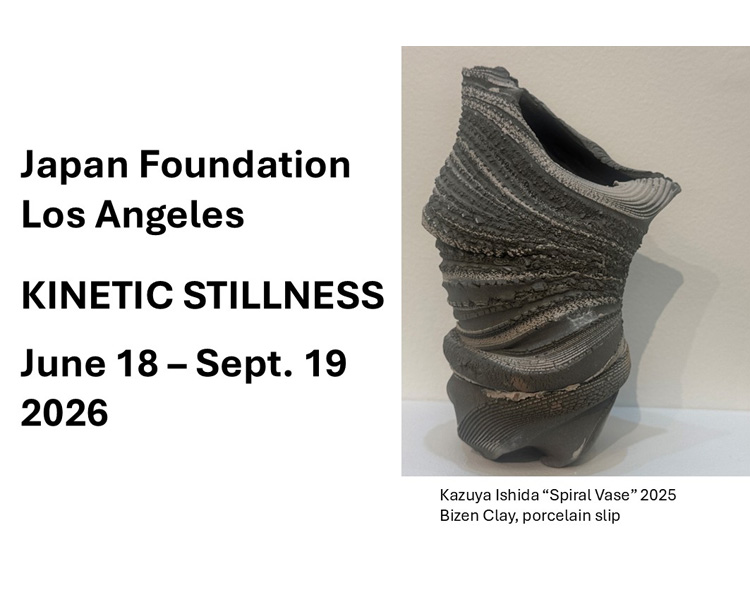
NOW | Japan Foundation LA | KINETIC STILLNESS: Sculptural Ceramics Exhibition | June 18 – Sept. 19, 2026
Posted on June 12, 2026
Japan Foundation Los Angeles presents KINETIC STILLNESS: Sculptural Ceramics Exhibition from Thursday, June 18 through Saturday, September 19, 2026.
Exhibition Hours: Monday – Friday 12:00pm-6:00pm, Saturday 10:00am-3:00pm
Closed on Sundays & Holidays (June 19, July 3, 4, 20, August 11, and September 7)
OPENING RECEPTION: RSVP HERE
7:00 – 8:30 PM, Thursday, June 18, 2026
Through the concept of kinetic stillness, this exhibition brings together seven Japanese and Japanese American artists who approach ceramics not as vessels for utility or tradition, but as sculptural sites of flux. Through bending, pressing, collapsing, and building, their works foreground the artists’ physicality and material processes, capturing the moment where form holds movement and stillness pulses with memory, while also pointing to a deeper temporal condition within clay itself. Each form bears the imprint of motion and history, embodying what we call kinetic stillness, an energy suspended in silence.
Rooted in geographically oriented Japanese ceramic traditions, some artists are heirs to centuries-old techniques, now pushing those methods toward abstraction or impermanence. Others are Japanese and Japanese American mixed media artists engaging in deep dialogue with the possibilities of clay among other materials.
Featured artists include Chie Fujii, Kazuya Ishida, Takashi Horisaki, Kuniko Kinoto Rino Kodama, Kenta Takaki, and Shoshi Watanabe.
Curated by Kaoru Kuribayashi
Special thanks to a poco art and ATLA
ARTISTS
Chie FUJII
Chie FUJII, a Japanese artist/ceramics maker currently based in Los Angeles, majored in and mastered sculpture and fine art at the Tokyo University of the Arts. Fujii has an extensive background in clay art, using traditional/ancient hand-build techniques that explore the passage of time from antiquity to the present. Fujii currently works as a full-time artist, before 2020, she alongside worked as a studio specialist in the clay department of automotive design studios such as Tesla Design Studio and Honda R&D. Fujii also makes practical items under the name CHIECO Ceramics. When she made her first practical item while making art, she was impressed that it could be blended into daily life and used every day. This is what triggered her to start making practical items. Incorporating art into daily life. That was the main reason she started making practical items.
Kazuya ISHIDA
Kazuya Ishida was born into a family of potters in Bizen Japan. Bizen is one of the six ‘ancient kilns’ and is famous for its traditional unglazed high temperature-fired bizen-style pottery. He uses wood-fired noborigama (multiple chamber climbing kiln) and anagama (single chamber climbing kiln). He trained with Jun Isezaki (a Living National Treasure in Bizen) for four years, followed by time spent in the UK learning different styles of pottery, before he established his own studio in Bizen. Invited into the Anagama Project run by University of Oxford, he has been a lead resident potter teaching kiln making, firing and pottery making, while lecturing about his craft. He makes sculptures and vases featuring his distinctive spiralling marks, created with a technique inspired by a teenage love for breakdancing. In using limited materials (specifically, natural clay and natural ash glazes) in line with the Bizen tradition, he explores the rhythms and patterns of Nature. The contemporary forms of his work are a reflection of the primordial, rippled textures and patterns of the ocean bed, tectonic shifts of a cliff face, and the marks that ebbing tides have left on rock pools, pebbles and seashells.
Takashi HORISAKI
Takashi Horisaki draws inspiration from architecture, urban planning, and material culture to examine how our physical surroundings intersect with cultural imaginaries, creating a sense of where we belong in the world. Sometimes he uses latex, plastic, or other moldmaking processes to collaboratively collect indexical objects; at other times he uses ceramic and photographic processes to reproduce flat images in three dimensions and vice versa. In his “Social Dress” series, Horisaki has examined how the built environment intersects with social inequality and community-building, working with marginalized communities on creating new self-images through the accessible medium of liquid latex casting combined with community conversation, thus grappling with difficult and conflicting local histories. More recently, Horisaki’s ceramic and photographic “#Instabonsai” series has explored the circulation and transnational development of bonsai as a form through which the cultural politics and formal limits of “Japanese” and “Asian” identities and cultures are negotiated. Through such investigations, Horisaki creates sculptural installations that re-present our physical surroundings, altering the form, rigidity, or color of familiar objects. Combined with storytelling—as recorded in oral histories, photographs, social media, performative lectures, or augmented reality—Horisaki considers the role our material surroundings play in the social life of an ostensibly de-materializing age.
Kuniko KINOTO
“I want to become a stone”
Kuniko Kinoto (b. 1976, Shiga Prefecture, Japan) is a ceramic sculptor whose practice traces the shifting boundary between natural phenomena and human intervention. She lives and works in Shiga, near the historic Shigaraki Ceramic Sculpture Park — a region long recognized as a vital center of ceramic innovation.
Educated in glaze research at the Shigaraki Ceramic Research Institute, Kinoto developed a nuanced understanding of material behavior through years of working with traditional noborigama kilns. This early immersion in the chemistry and choreography of firing continues to shape the precision and experimentation at the core of her practice.
Her work reflects a distinct synthesis of technical mastery and conceptual clarity, producing sculptural forms that echo geological transformation while retaining a deliberate, human-made presence.
Her solo presentation at ATLA in November 2025 marked her first presentation in the United States.
Rino KODAMA
Currently based in Albion, California, I am a second generation Japanese American artist and writer. Where my practice begins with poetry to explore themes of grief and transformation, they merge into life size ceramic sculptures, a celebration of the more than human world, inconstant relationship and learning from the regenerative life all around us. Collaborating with the elements of fire and earth, I use repetitive coil building techniques, where clay becomes a medium for protection, somatic processing, ritual, and celebration. My clay vessels are extensions of my genderqueer body, malleable, undergoing stages of transformation, the way clay goes from its original to fired form. My earliest collaborations are with my mother, Tomoko Kodama, a gardener and florist who regularly creates arrangements for the vessels I create, and who was the first person who showed me the importance of planting and nurturing beauty in our lives. Outside of my ceramic practice, I find joy in working with other queer and trans artists searching and creating spaces of belonging. I am a co-editor of Letters to Home: Art and Writing by LGBTQ Nikkei and Allies, an anthology of works by Japanese American queer and trans folks and their families, on ways they have co-constructed community .
Kodama holds a BA from UCLA, and most recently attended the inaugural session of Schools of Salmon Creek, co-creating and learning with 5 other artists on Pomo land. They recently completed their School Guide position at Salmon Creek, stewarding the next cohort of artists to experiment and develop a connection to their bodies, land, practice, and each other. They are currently living and creating work at Cider Creek Collective, a residency centering the use of local material and wood firing.
Kenta TAKAKI
Kenta Takaki was born in Kumamoto Prefecture in 1986. As a young man, he studied ceramics under Kazuhiro Kanazawa, a fifth-generation potter making Maruo Ware, a popular local ceramic made of red clay. After his apprenticeship with Kanazawa, he became independent and in 2016 established his own kiln working in Amakusa porcelain because he was attracted by the charm of porcelain and its possibilities. He works exclusively in Amakusa clay, a pure white porcelain that has been mined and used in the Amakusa region near Kumamoto for over 250 years. Using this fine porcelain clay, Takaki creates utilitarian vessels for eating and drinking, including elegant bowls and slender dishes. Unlike many traditional porcelains, these vessels are coated with a transparent glaze and no decoration, to emphasize the purity of the clay and the grace of the forms. In addition, the energy of the clay motivates Takaki to create thought-provoking sculptural works – often mimicking other materials, such as paper and food.
Shoshi WATANABE
Shoshi Watanabe is a Japanese ceramicist and teacher based in Los Angeles. As a high school student in Tokyo, Watanabe first began working with clay and considers his exposure to the culture of ceramics in Japan to have had a considerable influence on the style of his functional work. In 2014, he completed an MFA in ceramics from UCLA, where he now supervises students and maintains a studio. Having lived in Los Angeles for 15 years, and worked closely with mentor Adrian Saxe, his work has gradually come to blend Western and Japanese styles and techniques.
Watanabe draws considerable inspiration from Los Angeles: color palettes, a sense of ease and utility, a diversity of cultures. Some of his most-used glazes are based on 50-year-old glaze recipes from California, passed down by Saxe. California runs deeply through his practice, even as his sense of rhythm and balance, and hand-application of glazes, distinctly recall Japanese traditions. Watanabe sees ceramics as alchemy, in which elements derived from the earth — clay, minerals, and organic materials — are transformed to create artifacts that tie directly to their place of origin.